In 2014, a list of the Top 100 Eminent Psychologists of the Modern Era was published in the Archives of Scientific Psychology. [7] Canadian psychologist Albert Bandura was ranked number one. Former president of the American Psychological Association, winner of numerous awards and more than sixteen honorary degrees, and widely held as the most influential psychologist alive today, Albert Bandura is among the most prolific psychologists in history.
Author: David L
-

Distributed Cognition (DCog)
Summary: Distributed cognition is a branch of cognitive science that proposes cognition and knowledge are not confined to an individual; rather, it is distributed across objects, individuals, artefacts, and tools in the environment.
Originators: Edwin Hutchins in the 1990s.
Key Terms: Cognition in the Wild, mind in the world, artefacts, environment, representational media
-

Positive Psychology / PERMA Theory (Seligman)
Summary: Positive psychology is the study of happiness, flourishing, and what makes life worth living. Seligman points to five factors as leading to well-being — positive emotion, engagement, relationships, meaning and purpose, and accomplishment.
Originators and key contributors:
- Martin Seligman (1942-the present), American psychologist, founder of positive psychology
- Mihaly Csikszentmihalyi (1934-the present), Hungarian-American psychologist, co-founder of positive psychology, researched the concept of “Flow”
- Christopher Peterson (1950- 2012), American psychologist, The “VIA” and other topics in positive psychology
Keywords: flow, character strengths, well-being, happiness, positive emotion, engagement, relationships, meaning and purpose, and accomplishment
-
Deontology – Duty-Based Ethics (Kant)
One of the most influential ethical frameworks, deontology is focused on binding rules, obligation and duty (to family, country, church, etc.), not results or consequences.[1]
The term deontology comes from the Greek deon, “duty,” and logos, “science.”
Contributors
- Immanuel Kant (1724 – 1804), German philosopher
Key Concepts
Deontologists first consider what actions are considered “right” and proceed from there. This is in contrast to utilitarians who start by considering what things are good, and identify ‘right’ actions as the ones that produce the maximum of those good things.
What is my duty?
We may have a duty to our family, our country, or workplace, our religion.
“It is my duty to …”
Example: Do what my manager instructs me to do, even if I don’t want to do it or don’t agree. It is my duty to respect authority figures.
An act that may be considered wrong in and of itself, such as killing — could be considered appropriate in a deontology-based perspective if it is toward a duty. For instance, if there were a home invader threatening where you live, killing him or her in order to protect your family could be deemed right.
Strengths and advantages to this approach
There are various advantages to this kind of duty-based approach.
- No need for lengthy consideration of possible consequences
- Deals with intentions and motives
- Provides human dignity and intrinsic value
Weaknesses and criticisms to this approach
- Not as interested in effects of actions; therefore, there could be a reduction in the overall happiness of the world
- Difficult to handle conflicting duties
Additional Resources and References
Resources
- Internet Encyclopedia of Philosophy. https://www.iep.utm.edu/util-a-r/
References
- http://www.bbc.co.uk/ethics/introduction/duty_1.shtml
-
Humanism
Humanism is a paradigm / philosophy / pedagogical approach that believes learning is viewed as a personal act to fulfill one’s potential.
Contents
Contributors
- Abraham Maslow
- Carl Rogers
- Malcolm Knowles
Key Concepts
Humanism, a paradigm that emerged in the 1960s, focuses on the human freedom, dignity, and potential. A central assumption of humanism, according to Huitt (2001), is that people act with intentionality and values [1]. This is in contrast to the behaviorist notion of operant conditioning (which argues that all behavior is the result of the application of consequences) and the cognitive psychologist belief that the discovering knowledge or constructing meaning is central to learning. Humanists also believe that it is necessary to study the person as a whole, especially as an individual grows and develops over the lifespan. It follows that the study of the self, motivation, and goals are areas of particular interest.
Key proponents of humanism include Carl Rogers and Abraham Maslow. A primary purpose of humanism could be described as the development of self-actualized, autonomous people[2]. In humanism, learning is student centered and personalized, and the educator’s role is that of a facilitator. Affective and cognitive needs are key, and the goal is to develop self-actualized people in a cooperative, supportive environment[3].
Additional Resources and References
References
- Huitt, W. (2001). Humanism and open education. Educational Psychology Interactive. Valdosta, GA: Valdosta State University. Retrieved September 11, 2007, from the URL: http://chiron.valdosta.edu/whuitt/col/affsys/humed.html.
- Rogers, C., & Freiberg, H. J. (1994). Freedom to learn (3rd Ed.). New York: Macmillan.
- DeCarvalho, R. (1991). The humanistic paradigm in education. The Humanistic Psychologist, 19(1), 88-104.
-

Problem-Based Learning (PBL)
Problem-Based Learning (PBL) is an instructional method of hands-on, active learning centered on the investigation and resolution of messy, real-world problems.
Contents
Contributors
- Late 1960s at the medical school at McMaster University in Canada
Key Concepts
Problem-Based Learning (PBL) is a pedagogical approach and curriculum design methodology often used in higher education and K-12 settings[1][2].
The following are some of the defining characteristics of PBL:
- Learning is driven by challenging, open-ended problems with no one “right” answer
- Problems/cases are context specific
- Students work as self-directed, active investigators and problem-solvers in small collaborative groups (typically of about five students)
- A key problem is identified and a solution is agreed upon and implemented
- Teachers adopt the role as facilitators of learning, guiding the learning process and promoting an environment of inquiry
Rather than having a teacher provide facts and then testing students ability to recall these facts via memorization, PBL attempts to get students to apply knowledge to new situations. Students are faced with contextualized, ill-structured problems and are asked to investigate and discover meaningful solutions.
Proponents believe that PBL:
- develops critical thinking and creative skills
- improves problem-solving skills
- increases motivation
- helps students learn to transfer knowledge to new situations
History
PBL’s more recent influence can be traced to the late 1960s at the medical school at McMaster University in Canada[3][4]. Shortly thereafter, three other medical schools — the University of Limburg at Maastricht (the Netherlands), the University of Newcastle (Australia), and the University of New Mexico (United States) took on the McMaster model of problem-based learning. Various adaptations were made and the model soon found its way to various other disciplines — business, dentistry, health sciences, law, engineering, education, and so on.
Criticisms
One common criticism of PBL is that students cannot really know what might be important for them to learn, especially in areas which they have no prior experience[3]. Therefore teachers, as facilitators, must be careful to assess and account for the prior knowledge that students bring to the classroom.
Another criticism is that a teacher adopting a PBL approach may not be able to cover as much material as a conventional lecture-based course[3]. PBL can be very challenging to implement, as it requires a lot of planning and hard work for the teacher. It can be difficult at first for the teacher to “relinquish control” and become a facilitator, encouraging the students to ask the right questions rather than handing them solutions.
Additional Resources and References
Resources
- Thinking Through Project-Based Learning: Guiding Deeper Inquiry: Krauss & Boss’s book contains many practical examples of how to teach and create critical thinking experiences in project-based learning.
- Essential Readings in Problem-Based Learning: Exploring and Extending the Legacy of Howard S. Barrows: Walker, Hmelo-Silver & Ertmer’s book discusses developments in the field of PBL, bridging the gap between theory and practice.
References
- Barrows, H. S. (1986). A taxonomy of problem?based learning methods.Medical education, 20(6), 481-486.
- Savery, J. R., & Duffy, T. M. (1995). Problem based learning: An instructional model and its constructivist framework. Educational technology, 35(5), 31-38.
- Boud, D., & Feletti, G. (1997). The challenge of problem-based learning. Psychology Press.
- Barrows, H. S. (1996). Problem?based learning in medicine and beyond: A brief overview. New directions for teaching and learning, 1996(68), 3-12.
-

Classical Conditioning (Pavlov)
Classical conditioning is a reflexive or automatic type of learning in which a stimulus acquires the capacity to evoke a response that was originally evoked by another stimulus.
Contents
Contributors
- Ivan Pavlov (1849 – 1936)
- John B. Watson (1878 – 1958)
Key Concepts
Several types of learning exist. The most basic form is associative learning, i.e., making a new association between events in the environment[1]. There are two forms of associative learning: classical conditioning (made famous by Ivan Pavlov’s experiments with dogs) and operant conditioning.
Pavlov’s Dogs
In the early twentieth century, Russian physiologist Ivan Pavlov did Nobel prize-winning work on digestion[2]. While studying the role of saliva in dogs’ digestive processes, he stumbled upon a phenomenon he labeled “psychic reflexes.” While an accidental discovery, he had the foresight to see the importance of it. Pavlov’s dogs, restrained in an experimental chamber, were presented with meat powder and they had their saliva collected via a surgically implanted tube in their saliva glands. Over time, he noticed that his dogs who begin salivation before the meat powder was even presented, whether it was by the presence of the handler or merely by a clicking noise produced by the device that distributed the meat powder.
Fascinated by this finding, Pavlov paired the meat powder with various stimuli such as the ringing of a bell. After the meat powder and bell (auditory stimulus) were presented together several times, the bell was used alone. Pavlov’s dogs, as predicted, responded by salivating to the sound of the bell (without the food). The bell began as a neutral stimulus (i.e. the bell itself did not produce the dogs’ salivation). However, by pairing the bell with the stimulus that did produce the salivation response, the bell was able to acquire the ability to trigger the salivation response. Pavlov therefore demonstrated how stimulus-response bonds (which some consider as the basic building blocks of learning) are formed. He dedicated much of the rest of his career further exploring this finding.
In technical terms, the meat powder is considered an unconditioned stimulus (UCS) and the dog’s salivation is the unconditioned response (UCR). The bell is a neutral stimulus until the dog learns to associate the bell with food. Then the bell becomes a conditioned stimulus (CS) which produces the conditioned response (CR) of salivation after repeated pairings between the bell and food.

John B. Watson: Early Classical Conditioning with Humans
John B. Watson further extended Pavlov’s work and applied it to human beings[3]. In 1921, Watson studied Albert, an 11 month old infant child. The goal of the study was to condition Albert to become afraid of a white rat by pairing the white rat with a very loud, jarring noise (UCS). At first, Albert showed no sign of fear when he was presented with rats, but once the rat was repeatedly paired with the loud noise (UCS), Albert developed a fear of rats. It could be said that the loud noise (UCS) induced fear (UCR). The implications of Watson’s experiment suggested that classical conditioning could cause some phobias in humans.
Additional Resources and References
Resources
- McSweeney and Murphy: The Wiley Blackwell Handbook of Operant and Classical Conditioning.: This brand new book contains an up-to-date, inclusive account of a core field of psychology research, with in-depth coverage of operant and classical conditioning theory, its applications, and current topics including behavioral economics.
References
- Mackintosh, N. J. (1983). Conditioning and associative learning (p. 316). Oxford: Clarendon Press.
- Pavlov, I. P., & Anrep, G. V. (2003). Conditioned reflexes. Courier Corporation.
- Watson, J. B. (2013). Behaviorism. Read Books Ltd.
-
Multiliteracies (New London Group)
Summary: Multiliteracies is a pedagogical approach developed in 1994 by the New London Group that aims to make classroom teaching more inclusive of cultural, linguistic, communicative, and technological diversity. They advocate this so that students will be better prepared for a successful life in a globalized world.
Originators & Proponents: New London Group
Keywords: communication, community engagement, cultural diversity, education, expression, globalization, language, linguistic diversity, literacy, modes, multimodality, pedagogy, technology
-

Bloom’s Taxonomy (Bloom)
Bloom’s Taxonomy is a model that is a hierarchy — a way to classify thinking according to six cognitive levels of complexity.
Contributors
- Benjamin S. Bloom (1913-1999)
Key Concepts
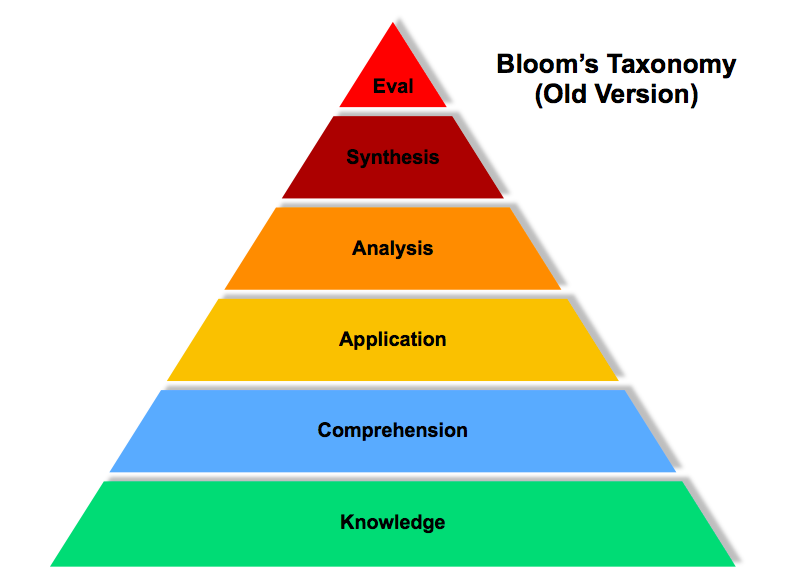
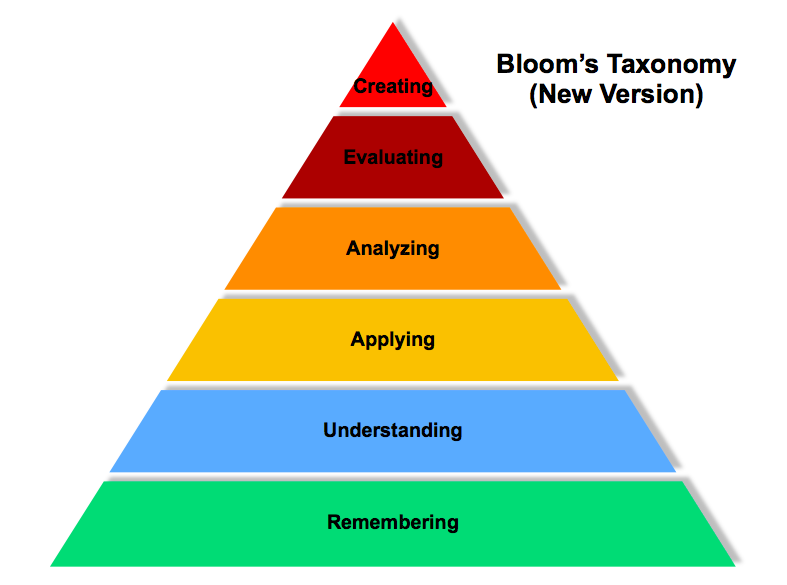
Bloom’s model consists of six levels, with the three lower levels (knowledge, comprehension, and application) being more basic than the higher levels (analysis, synthesis, and evaluation)[1]. Some think of the levels as a stairway, in which learners are encouraged to achieve a higher level of thinking. If a student has mastered a higher level, then he or she is considered to have mastered the levels below.
Bloom’s model has been updated to account for 21st century needs[2]. The old model and new model are depicted below.
Old Model
New Model
Additional Resources and References
References
- Bloom, B. S. (1956). Taxonomy of educational objectives: The classification of educational goals.
- Anderson, L. W., Krathwohl, D. R., & Bloom, B. S. (2001). A taxonomy for learning, teaching, and assessing: A revision of Bloom’s taxonomy of educational objectives. Allyn & Bacon.